Fort Myers Quakers

Religious Society of Friends

  • Fort Myers Quakers
  • Home
  • About
    • Quaker Beliefs: The Testimonies
    • About Quaker Beliefs
    • Why Quakers Speak Out
    • Our Meeting
    • How We Worship
    • Sunday Schedule
    • Sunday School
    • Queries
    • The Wider Quaker World
      • Conscientious Objector Status
        • The Basis of the Peace Testimony
        • Registration for the Draft
        • Are you a Conscientious Objector?
        • How to Qualify for Conscientious Objector Status
        • How to Discern Your Path if You are a Conscientious Objector
        • How to Document Your Conscientious Objector Beliefs
        • Resources on Conscientious Objection
  • Events
    • News…
  • Community
    • Fort Myers Monthly Meeting Directory
  • Contact Us – 239-318-0538
You are here: Home / Archives for Pat Iyer

January 17, 2018 By Pat Iyer Leave a Comment

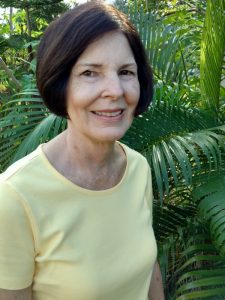
Marianne at the Fort Myers Quaker Meeting

MarianneMarianne’s son calls her the “mystic momma”. One of her most distinctive qualities is the ability to create the lyrics and a song while sitting in silence during a Quaker meeting for worship. “I never had the experience of having a song come to me before”, she says. “I did not know what to do the first time it happened to me. It was a powerful experience I knew I had to share. Although I argued with myself for a long time, I knew I was supposed to share my songs. It gives me goosebumps.”

Marianne grew up in Southern California outside of Los Angeles. Her father was a carpenter. Her mother had 7 sisters and 3 brothers. Marianne’s uncle was a minister who was well known in the Church of God and ran tent revivals and a church in Kentucky. “I’m Church of God non-Pentecostal”, Marianne learned to say when growing up. But for her great great grandfather drifting away from religion, Marianne could have been raised Mormon. Her great great grandfather was one of Brigham Young’s inner circle.

Wayne and Marianne met when Marianne was at UCLA. Her cousin introduced them. (Wayne went to a Quaker college for one year and was exposed to programmed meetings.) They married after college and moved to Portland OR so Wayne could go to graduate school. While Marianne got a teaching job with kindergartners, Wayne completed his graduate degree in social work. Once Wayne completed the degree, they returned to Southern California for 4 years and had their first son before moving to West Virginia.

A charismatic and pathological liar psychiatrist convinced Marianne and Wayne and others to move to West Virginia to be part of a clinic called Total Life. The vision was to have Christian professionals work together and provide services under a grant from Johnson and Johnson, but there was no grant and no clinic. Marianne and Wayne got other jobs for the 5 years they were in West Virginia before moving to Northern California (the Santa Rosa area) where they raised their family of 2 boys and a girl.

Marianne hurt her back while pregnant with her daughter and was limited in her ability to go out. For 15 years a minister ran a care group for 10 people in Marianne and Wayne’s home until Marianne’s back got better, and she was able to return to teaching. During this time, she and her brother, his wife, and two cousins formed an oldies rock ‘n’ roll band, The Passions, playing local parties and school events. She calls it a blast from the past!

When her back deteriorated again, she retired, and they moved to Kentucky where her son ran a church. Her son was trained as a Southern Baptist minister, was a senior pastor at a Methodist church and ultimately found the Mennonite faith most appealing to him. He, his wife and their children live in Harrisonburg Virginia, where Wayne and Marianne spend their time when not in Florida. Their other son lives near Santa Rosa and their daughter is in Denver.

The journey to Fort Myers Quakers began with Marianne’s Google search for “socially involved churches”. She had never been to a Quaker meeting and was intrigued. Not knowing what to expect, she thought she’d find people dressed like the man on the Quaker oats box. Nancy M was the first person Marianne saw when she entered the meetinghouse. Nancy’s flaming red hair and leopard print dress reassured Marianne she’d fit in.

The silent meeting for worship perfectly suits Marianne. She would not go to a programmed meeting. There is a Quaker meeting near Harrisonburg, but songs do not come to her there. Until she found the Quakers, she says she has never been part of a church where she felt nurtured. She has found nurturing and her songs at Fort Myers Quaker Meeting.
Filed Under: Blog

December 17, 2017 By Pat Iyer Leave a Comment

Wekiwa Springs State Park and Half Yearly Meeting November 2017

The annual South Eastern Yearly Meeting gathering, held over Thanksgiving weekend (November 23 -26), again was celebrated at the Youth Camp in Wekiwa Springs State Park.

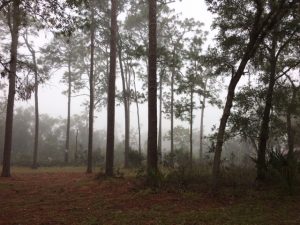
Morning mist
Morning Mist
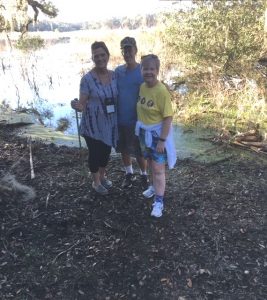
Chris Ruhnke, Vicki Scott and Pat Iyer traveled together to the event on Friday morning and left after meeting for worship on Sunday. We stayed in the youth camp which was tucked into the park. Vicki and Pat were delighted that the women stayed in the infirmary which had two bed rooms and heat. Chris stayed with his friend Mike who came from Dallas with two teenage boys from Thailand. Mike’s first exposure to Quakers took place at the meeting. The boys enjoyed the exposure to the teenage girls who were present at the camp.

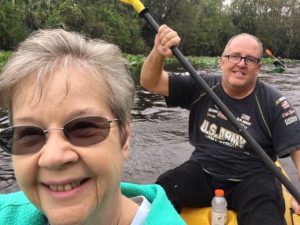
Our planned kayak trip was affected by the many trees felled over some sections of Rock Springs Run and the Wekiva River, making many parts impassible. Pat had an opportunity to experience what it is like to paddle against a current on Rock Springs Run, making her appreciate the still waters in SW Florida. But she appreciated the power of having Mike behind her, as he was better than an outboard motor. Pat and Mike

So named because this group of Quakers gets together mid year before the annual (or yearly) meeting, Half Yearly Meeting at Wekiwa Springs State Park had a minimum of structured activities but plenty of opportunities for hikes, swimming and canoeing, with an emphasis on connecting with our wider South Eastern Yearly Meeting community and ample time for personal reflection. Vicki, Chris and Pat enjoyed an extended hike in the woods after a morning of kayaking. Vicki, Chris and Pat

On Friday evening, there was a remembrance ceremony/workshop led by Jane Westberg and Kody Hersh, “Towards Right Relationship with Native Peoples.” We learned about how the American Indians were systematically and persistently driven off their land. The impact of the workshop was powerful and highly emotional.

In sharp contrast to the seriousness of the Friday workshop, we had our annual NO TALENT NECESSARY talent show Saturday night, hosted by Vincent Cosomono and Aurelio Anderson. The show included gymnastics, violin playing, a play, poetry, singing and Quaker humor. After the show Saturday night, we had a campfire where we roasted marshmallows for s’mores, sang songs and told scary stories.

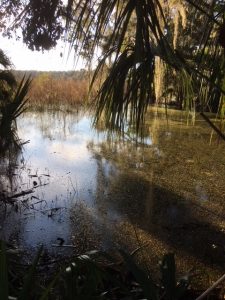
Lake and shadows at Wekiwa State ParkWe ended the weekend with meeting for worship in a screened in building on the edge of a lake. Although we could see the cars passing on the edge of Wekiwa Springs State Park, we felt like we were in the middle of wilderness. It also felt like a little vacation and promoted an opportunity to meet Quakers from around the state.
By Pat Iyer and Carl Hersh, with additional contributions from Jerry Knutson, Beverly Ward and Miami Friends

Filed Under: Blog

April 16, 2017 By Pat Iyer

Helen

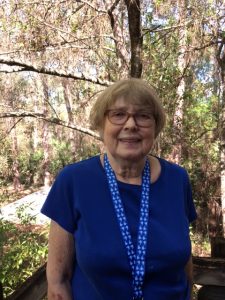
Helen embraced Quaker values long before she became one. She spent her childhood in Hyde Park, a neighborhood on the south side of Chicago that thought of itself as a liberal, integrated community but in reality, was quite segregated. She went to Hyde Park High School, which, by the time she graduated, was about 80% black and very diverse in terms of economic class. Some of the black students came from the area where Barack Obama lives, a wealthy, black enclave.
Many others were very impoverished; their families had been part of the Great Migration from the south that brought them to Chicago for jobs in the steel mills and stockyards. Blacks lived in very poor housing, totally separated from whites of any class. At school, black and white students were discouraged from mixing socially or educationally. This situation was troubling for many teens, yet few dared challenge the unspoken rules about race.

Brought up to be a skeptic by her atheist, cosmopolitan mother, Helen was encouraged to attend the churches and synagogues of her friends but at that point in her life, she did not identify with any particular religion.

After starting school early because of an October birthday and skipping a few grades, Helen was in college before she turned 17. She went to the University of California at Berkeley, which she chose more for its beautiful environment and its closeness to the mountains and the sea than for its rigorous science program. However, she did well, and graduated Phi Beta Kappa in 1964, just as the Free Speech Movement was beginning to roil the campus.

Peace Corps in India

While still in college, Helen married a fellow student. Right after she graduated with her degree in biology, she and her husband joined the Peace Corps. They were sent to India, to the remote area of Tripura, east of what is now Bangladesh (then East Pakistan). Helen became a science teacher at a junior college, teaching introductory biology and some of the science courses she had just completed at Berkeley.

Although her Indian students were excellent, Helen and several of her fellow Volunteers soon realized that the Indian school system relied almost exclusively on memorization. Students had little understanding or interest in applying what they had learned to the natural world. Helen and her husband managed to convince the Minister of Education to run a series of short courses (or inservice training) for elementary school science teachers from all over the State of Tripura. Groups of teachers came to the college for a month, where they learned to teach their young students the practical aspects of observing nature and doing science in the field. After training many teachers, she had the opportunity to visit some of them in their schools in the beautiful, remote jungle areas.

Helen’s Peace Corps work coincided with the time that hostilities were breaking out between India and Pakistan. She and her husband lived close to border. War activity meant that kerosene and food were rationed, trenches were dug outside of the house, and windows had to be blacked out at night. Peace Corps finally evacuated the five Tripura Volunteers to Assam, and then on to Darjeeling, where they spent several months at a language school. Later, Helen became pregnant with her first daughter, who was born in Tripura after the hostilities had ceased.

Return to the U.S.

Helen and her family returned to the U.S. by way of Moscow, which in those days had few U.S. visitors. They then flew over the North Pole to Alaska, bought a car, and traveled to California via the Al-Can Highway, which at that time was a two-lane gravel road. Back in Berkeley, they decided to move to Boston, where her husband would attend graduate school. Although Helen was somewhat frustrated staying home with the baby, she was skeptical both of the Women’s movement, which was active at that time, and of graduate programs that seemed both ethnocentric and disconnected from what she saw as “real life.” Having seen dire poverty in India, she wanted to learn more about poverty in her own country.

Helen found a job at a Settlement House in Roxbury, where she started a program for preschool and school age children who had been rejected by the public schools. This was before public schools were required to allow children with disabilities and mental illness to participate in classrooms. Seeing the need for this school, Helen read all she could find on the topic at the library, talked to social workers and, with support from the Settlement House, began the program with a dozen children and volunteers from the community. It was a fascinating, if disheartening introduction to U.S. poverty, the welfare system, and the ways that public institutions were marked by race. Helen’s involvement with the school took place during the era of Boston-area demonstrations against busing, the rise of Black Power, the Black Panther movement, the assassination of Martin Luther King, and of course, the Vietnam War.

Although Helen was not politically active in college, her experiences in India and Boston began to radicalize her. She became frustrated with the contradictory way her country was treating vulnerable people, both at home and abroad. The U.S. was promoting foreign aid through the Peace Corps at the same time it was bombing Vietnam, at that time one of the world’s most impoverished countries. The U.S. government was sponsoring anti-poverty programs, but turning a blind eye to the needs of racial minorities, particularly their most vulnerable children. Finally, like many young adults of that era, Helen “dropped out,” hoping to find an alternative route to a better world. In the process, she divorced her first husband, and, with her young daughter, moved into a commune.

Helen’s second husband, an “intelligent drop-out” who she met in the commune, moved with her around the country for a while, finally settling in Quebec. There, they made a home in the countryside where their three daughters were raised to be bilingual in French and English. While enjoying rural life, Helen taught English as Second Language to adult French speakers while training herself to become a writer. She tried her hand at children’s stories and plays, science writing for primary school teachers, and op-ed pieces on social issues for U.S. newspapers. She had little success getting published, but she persisted, papering her walls with rejection slips. After 15 years, her second marriage dissolved, and she was on her own with a teenager and a pre-teen.

Return to the U.S.

Helen saw that the only way she could support her family was to get a higher degree. Fortunately, she was accepted at a graduate program that turned out to be a perfect fit for her: The Center for International Education at the University of Massachusetts, Amherst. The program was designed for mid-career professionals, half of whom came from the Global South. Through her friendships with international students she became interested in cultural issues in academic writing, which became the focus of her doctoral research. After five years in the combined Masters-Doctoral program, she received her Doctorate in Education. Along the way she had many interesting work opportunities that included trips to Cote d’Ivoire, Togo, and the Solomon Islands.

Helen was relieved and excited to be offered a job in the writing program at the University of Michigan, and moved to Ann Arbor in 1991. During the next 22 years, she taught undergraduate courses in academic writing, race and racism, international development, human rights, and nonviolent social movements.

Helen was pleased to discover that getting published is much easier when affiliated with a university. She has since written a number of books:

Listening to the World: Cultural Issues in Academic Writing (based on her dissertation)
“When Race Breaks Out”: Conversations about Race and Racism in College Classrooms (now going into its 3rd edition)
Their Highest Vocation: Social Justice and the Millennial Generation
Fractured: Race Relations in “Postracial” American Life (her most recent book)

Early on in her time at U of M, Helen was lucky enough to find Jim Koopman, a professor of epidemiology who also loved to travel and enjoyed the natural world. They have been happily married since 1998. Between them they have 5 adult children and 5 grandchildren. Helen and Jim live half the year in Bokeelia on Pine Island and half the year in Ann Arbor. Technology allows them to stay connected with colleagues and to carry on some of their work while here.

Introduction to Quakers

When she arrived at the University of Michigan in 1991, Helen was looking for group of friends who shared similar values. Some of her colleagues were Quakers, and soon they invited Helen to a Quaker meeting which was across the street from the university.

The first time Helen entered the meetinghouse she immediately found it appealed to her. The silent worship, the heartfelt testimony, the appeal to the mysterious, and the open, un-programmed nature of the Meeting spoke to her. She recalls a very old man who did not speak of God, but of visiting the cloud forest in Costa Rica and his awe of nature. She began learning more about Quakers and after a few years, she decided to become a member of the Ann Arbor Meeting.

Fort Myers Monthly Meeting

When Jim and Helen decided to spend six months of the year in Florida, Helen knew she needed to find a Quaker Meeting. Initially she thought the closest one was an hour and half drive, but then discovered the Fort Myers Monthly Meeting was only 45 minutes away. She immediately felt extremely welcomed and at home.

These are some of the Quaker highlights for Helen:
• Quaker antiwar and nonviolence values resonate with her. She has taught about nonviolence and the many alternatives to war.
• Quaker methods of clerking meetings are applicable to other situations in her work and civic engagement, for example, when she has been called to facilitate hard discussions around race, chair the Ann Arbor Human Rights Commission, or Clerk the Board of Friends School in Detroit.
• The Quaker history of speaking truth to power has helped her become an activist on controversial issues such as the Israel Palestine conflict and racial justice.

Although Helen formally retired four years ago, she continues to teach a mini-course on race in the fall at the University of Michigan. This gets her back in touch with students, whom she sometimes misses. But she is finding new interests and new friends at the Randell Research Center on Pine Island, where she is a Docent-in-Training on the Calusa Heritage Trail.

Filed Under: Blog

March 16, 2017 By Pat Iyer Leave a Comment

Jeannette B

This month’s spotlight is on Jeannette, who was born and grew up in Durban, South Africa. After living the U.S. from age 2 to 10, Jeannette and her family returned to South Africa. Jeannette lived in South Africa during apartheid. Apartheid was a political and social system in South Africa while it was under white minority rule. This was in use in the 20th century, from 1948 to 1994. Racial segregation had been used for centuries but the new policy started in 1948 was stricter and more systematic.

These laws also inaugurated a new phase in the African National Congress (ANC) history. In 1952, the ANC launched the Defiance Campaign against apartheid. With a broadened base that now included women, it adopted the Freedom Charter in June 1955 which declared that South Africa belonged to all of its residents regardless of race.

A militant nationalist group insisted that South Africa belonged to blacks and formed a rival organization, the Pan African Congress (PAC). Both organizations became involved in anti-apartheid resistance and were subsequently implicated in a defiance campaign that provoked violent reprisals in Sharpeville in 1960. The Sharpeville Massacre where 69 protestors were killed by South African police who fired on 300 demonstrators, unleashed worldwide condemnation of the nation. In response, the government declared a state of emergency, and banned both the ANC and the PAC.

Jeannette was raised in the Swedenborgian religion, a religion founded by a Swedish man named Emanuel Swedenborg who lived 1688 to 1772. As a minister, Jeannette’s father ran a school for black ministers. His secretary was a black man. Jeannette suspects her father and his secretary were involved in ANC resistance activities. The police came to the house one night at 3 AM to inspect her father’s offices, found nothing and left.

Jeannette was aware of the demeaning effects of apartheid. She recalls being upset that the gardener was called “boy” and the maid was called “girl”. As a child she saw a sign on the school bus stop bench that read, “For Europeans only”. She said, “That does not apply to me. I am an American.”

Jeannette trained to be a registered nurse in South Africa. She comments that nursing school placed a big emphasis on hands on training and less on book work.

Move to the U.S.

After marrying and having children in South Africa, Jeannette and her family moved to the United States. Her family sponsored her husband so he could enter the United States. Jeannette had 4 children within 6 years.

Jeannette and her husband and children have lived in Pennsylvania, North Carolina, Delaware and Florida. Her husband was the vice president of a large cotton mill in North Carolina and retired as the mills were moving activities oversees.

A Quaker nursing home provided Jeannette’s first exposure to Quakers. She worked as an aide there and had additional jobs in doctors’ offices. She did not work as an RN in the U.S.

Jeannette’s husband retired at age 57 or 58, followed by a move to Florida because two of their daughters live locally in Buckingham, FL.

Unfortunately Jeannette’s husband developed Alzheimers. Medications helped him for 6-7 years, and then he deteriorated. He loved attending Fort Myers Meeting, where people fussed over him. He died at the end of December 2016.

A grandmother 5 times over, Jeannette enjoys seeing her 2 daughters who live in Buckingham. Her grandchildren are local. Another son and daughter live in Atlanta. Jeannette loves to be in nature. She has walked in every park in Lee County. She is particularly fond of Corkscrew Swamp and the 6 Mile Slough.

When Jeannette connected with Fort Myers Monthly Meeting, she said, “This is my spiritual home.” She says she is not very fundamentalist and believes there is a spiritual meaning to life, and that Christ is within. She takes Quakerism as a whole.

Advice for New People

If you are new to Quakerism, Jeannette advises you to get involved by joining a committee, come to the potluck lunches (the first Sunday of the month) and participate in religious education. Get to know people within the meeting. You will feel welcomed.

Filed Under: Blog

  • « Previous Page
  • 1
  • …
  • 3
  • 4
  • 5
  • 6
  • 7
  • 8
  • Next Page »

Recent Posts

  • The War in Israel and Palestine
  • I expect to pass through this world but once…
  • We humans make things so difficult…
  • Donate for Gaza
  • (no title)

Recent Comments

    Archives

    • January 2025
    • December 2024
    • November 2024
    • October 2024
    • August 2021
    • March 2021
    • June 2019
    • May 2019
    • April 2019
    • February 2019
    • January 2019
    • February 2018
    • January 2018
    • December 2017
    • April 2017
    • March 2017
    • February 2017
    • January 2017
    • December 2016
    • November 2016
    • October 2016
    • September 2016
    • August 2016
    • July 2016

    Categories

    • Blog
    • Profile
    • Uncategorized
    • Video

    Categories

    • Blog
    • Profile
    • Uncategorized
    • Video

    Search Our Site

    Connect With Us

    • Facebook
    • YouTube

    Handcrafted with on the Genesis Framework