Fort Myers Quakers

Religious Society of Friends

  • Fort Myers Quakers
  • Home
  • About
    • Quaker Beliefs: The Testimonies
    • About Quaker Beliefs
    • Why Quakers Speak Out
    • Our Meeting
    • How We Worship
    • Sunday Schedule
    • Sunday School
    • Queries
    • The Wider Quaker World
      • Conscientious Objector Status
        • The Basis of the Peace Testimony
        • Registration for the Draft
        • Are you a Conscientious Objector?
        • How to Qualify for Conscientious Objector Status
        • How to Discern Your Path if You are a Conscientious Objector
        • How to Document Your Conscientious Objector Beliefs
        • Resources on Conscientious Objection
  • Events
    • News…
  • Community
    • Fort Myers Monthly Meeting Directory
  • Contact Us – 239-318-0538
You are here: Home / Archives for 2016

Archives for 2016

September 12, 2016 By Pat Iyer Leave a Comment

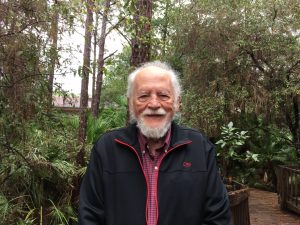
Tom

Tom

Had it not been for orchids, it is likely that Tom  would not have been a doctor.

Tom was born on July 4th. For years, he thought the July 4th celebrations were for him. Because Tom’s father was employed by the U.S. Department of Agriculture, Tom’s early years were spent in Florida, Haiti and Puerto Rico. After finishing 5th grade, Tom and his brother had the opportunity to go to boarding school in Michigan. Cranbrook School had a great reputation. Tom found living in boarding school was easy if you behaved yourself, and he was raised to follow the rules. He loved this Episcopalian school and left it at graduation to enroll in Harvard University. Although he originally planned to be a teacher, he got interested in medicine, but there were no scholarships available and his family could not afford to send him to medical school.

Tom’s grandfather developed a business growing orchids. After buying 25 acres of land near Miami in 1923, he found the land was ideally suited to grow orchids. His orchid farm became a tourist attraction, called the Orchid Jungle. Phillip Wiley wrote an article about this farm, which was published in the Saturday Evening Post. The year before the article came out, the business grossed $50,000. The revenue increased to $500,000 after the article was published.

Orchid money sent Tom to Duke University Medical School. The draft was in effect when he graduated in 1957, and since there were no paid internships, Tom joined the Air Force.   The Air Force eventually stationed him in Washington DC, where he served as a general medical officer for three years at Andrews Air Force Base.

While completing his undergraduate education at Harvard, Tom met and married his first wife. They had three children. Tom’s wife developed a panic disorder early in their marriage. Her condition was not well understood in those days and treatment options were limited. She spent much of her time hospitalized; Tom’s mother pitched in to help with the children. Tom made the decision to end the marriage shortly after their third child was born addicted to the illegal medications that his wife took.

Transition to Psychiatry

“Diseases bored me but people did not”, he says to explain his growing interest in psychiatry. He completed additional training in psychiatry at the University of Miami, studying under a top notch faculty of psychiatrists. Many were physicians who fled from Cuba after Castro took over. Tom found that psychiatry was a great match for his desire to take care of people. He stayed on the clinical faculty of University of Miami for 25 years, while also setting up and running a psychiatric practice. He provided psychotherapy to patients, regardless of their ability to pay. “I was one of the few poor doctors”, he explained.

Tom and Nancy met when she was working as a psychiatric aide at the University of Miami Psychiatric Institute. Nancy was divorced at the time and had an adopted a boy named Jeff. Nancy was working on gaining admission to graduate school to become a psychologist. The chief nursing administrator of the hospital, who was instrumental in guiding Tom as a psychiatric resident, asked Tom to supervise Nancy. Nancy’s life changed when she got admitted to Florida State University.

After Nancy moved to Tallahassee, Tom and Nancy started a long distance courtship. Nancy completed her 4 year program in 3 years. Her major professor insisted she be married before she did an internship; Nancy and Tom were too busy to plan their wedding. The professor’s secretary made all the arrangements for their wedding – Tom and Nancy just had to show up. They continued to live and practice in Florida.

Religious Beliefs

“I don’t want to go back to Sunday School”, Tom told his mother after his first experience at age 5. The uncharacteristically rebellious boy had no formal religious training until he was exposed to the Episcopalian Church in Haiti and in Michigan at Cranbrook. He found he liked the hymns and the music, but he started questioning some of the wording in the creeds. He omitted saying the parts he could not believe in until by the time he was a senior at Cranbrook, he could not agree with any of them.

At Harvard, Tom attended the Unitarian Church until he realized he could not endorse their support of some political issues. He became an agnostic.

Introduction to Quakerism

Nancy and Tom lived on 60 acres of forest in Highlands County. Nancy began attending Ft. Myers meeting and Tom joined her at a meeting for worship 6 months later. The first time he walked into Iona House, he felt an overwhelming powerful feeling that he had come home. He did not expect this. It was like a lightening bolt. He discovered that Quakers had no specific creed – he could sit and listen to God.

Tom finds the Quaker values that resonate the most with him are integrity, community, peace and earth care. He got rid of his gun collection 4 years ago when he realized he could not shoot anyone.

“God opened doors for me.” Tom explained.  He used to think he was “just lucky” but he realized that his life was guided by more than luck. He wanted to care for people and God opened the doors so that he could.


Filed Under: Profile

August 12, 2016 By Pat Iyer Leave a Comment

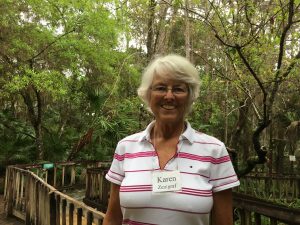
Karen

Karen Zentgraf

Lazy summer days floating down a salt water creek – Karen lights up when she remembers the idyllic summers spent at her mother’s family’s home. She grew up on Long Island where her family lived in the winter in Syosset and in the summer in a cottage on Centre Island/Oyster Bay on the north shore of Long Island. “Summers were great! We had a cottage on the creek. We were fast swimmers when we swam with the tide.   My grandmother used to have float parties where a group of family and friends used inner tubes to float with the tide.”

Karen’s father was an attorney who worked in banking law in Brooklyn. Her mother had lived abroad, and attended 13 schools before she enrolled in junior college. Karen’s mother spoke German and French. Karen’s paternal grandparents lived in Glen Cove on a farm. After they died, Karen’s parents moved into this house. When Karen’s parents died, Karen’s sister and brother had to dispose of 6 generations of possessions stored in the house. They sold off the land and the house, the end of an era.

When Karen was in 7th grade, her family moved from Syosset to Locust Valley. There Karen attended the Locust Valley Friends Academy. Karen knew her family were careful with their finances so she and her siblings could attend Friends Academy. Karen’s father and all his family were Quakers. She recalls her great grandmother sewing white nighties for the Friends Service Committee to be given to infants of displaced people from the war.

In contrast to the Quaker background of Karen’s father, Karen’s mother and her mother’s family were Christian Scientists. Her parents agreed their children would be exposed to both religions. Karen went every other month to Matinecock Friends Meeting for Worship and alternate months to the Christian Science Sunday School. In college (Vassar College) Karen realized she was trying hard to follow the beliefs of the Christian Scientists, but she could not accept them. Her thinking crystallized further when she wrote a paper on Quaker education for a senior year philosophy of education course. She learned more about Quaker beliefs and the importance of educating spirit, mind and body.

Karen and Hank met in Poughkeepsie, New York while he was working for IBM. The summer between Karen’s sophomore and junior college years, she participated in the “Experiment in International Living”. She lived and traveled in Germany with a German family. Hank participated in the “Experiments” Program by being a community ambassador to Chile. After completing their programs, Karen and Hank met by sharing a ride to an alumni meeting in Putney, Vermont. Hank volunteered to give Karen, who had no car, a ride to the meeting.  As they became better acquainted they discovered their mutual interest in swimming which strengthened their bonds. Hank and Karen had swimming dates in the Vassar College pool, generally followed by dinner.  They discussed religion as their relationship deepened. Hank had been raised Catholic. When they discussed marriage, there was a concern that the Church would require her to become Catholic and raise the children in the Catholic Church.   Karen and Hank were fortunate to find a priest who could handle their differences; the priest even advised Hank to find out more about Quakers and told him it was his responsibility to support Karen in her spiritual development.

Karen completed her degree in German at Vassar College and moved to Iowa for two years, where she taught German at the Scattergood School in West Branch. “It was a Peace Corps-like experience”, she explained. “The students, as well as the faculty were active in the upkeep and maintenance of the school, as well as the kitchen, (cooking, serving, and cleaning up meals), housekeeping (cleaning, laundry, painting, minor repairs and plumbing) and farm chores.  They milked the cows, collected the eggs and each sophomore raised a sow, attended her farrowing, and raised her piglets.”  While at Scattergood and during the summers, Karen also continued studying for her masters from Middlebury College German School as well as completing requirements for teacher certification.

After completing her masters, Karen and Hank were married in New York. Seven months after their wedding Hank transferred with IBM to Boulder, Colorado. When they first married, they attended both the Boulder Meeting for Worship and the Catholic Church. Hank fell away from the Catholic Church shortly thereafter.  They were involved with the Meeting, especially through their contact with the Carter family, whom the Meeting helped by sponsoring school lunches for them, while the Carter children integrated the schools in Drew, Mississippi.  The family visited the Carter family in Drew and had two of the Carter girls spend two summers with them in Boulder.  (For more information about the Carter family, read Silver Rights by Connie Curry.)

As their children grew, Hank and Karen realized the Quaker Meeting was not the best fit for their children at their ages, so they began attending the United Church of Christ. They have three daughters. One lives in Fort Collins, CO and the other two live in Austin.  Two grandchildren live in Austin and one in Colorado. When Karen and Hank’s Colorado daughter became ill, it was evident that it would help her daughter, son-in-law and granddaughter if Hank and Karen moved closer. Downsizing from two and a half acres to a small city lot in Fort Collins sweetened the deal.  Living in Boulder for four decades had been rewarding. Karen had enjoyed teaching English to women from other countries. But then the school administration where she taught insisted they wanted to have only Christian teachers. Karen and quite a few teachers resigned in protest and started their own school happily teaching English as a second language. Karen also taught swimming, lifesaving, babysitting and CPR at a local YMCA.  But the move to Ft. Collins has brought new activities as well as an annual move to warmer climes in the winter.  Here, too, they are finding new activities.

Karen and Hank have been married for 50 years as of October 2015. It is clear Karen lives her Quaker values. She is drawn to the concept of that of God in each person, and the concept of letting your life display your values. Before leaving for summer in Colorado, they will travel to Haiti in conjunction with Hope for Haiti. They have been doing volunteer work for this organization for a while and now have the opportunity to see the results of their work.


Filed Under: Profile

July 11, 2016 By Pat Iyer Leave a Comment

What to Expect in Quaker meeting for Worship

Filed Under: Blog Tagged With: What to expect

July 11, 2016 By Pat Iyer Leave a Comment

Be open to new ideas and approaches

Be open to new ideas and approaches

Filed Under: Blog

  • « Previous Page
  • 1
  • 2

Recent Posts

  • The War in Israel and Palestine
  • I expect to pass through this world but once…
  • We humans make things so difficult…
  • Donate for Gaza
  • (no title)

Recent Comments

    Archives

    • January 2025
    • December 2024
    • November 2024
    • October 2024
    • August 2021
    • March 2021
    • June 2019
    • May 2019
    • April 2019
    • February 2019
    • January 2019
    • February 2018
    • January 2018
    • December 2017
    • April 2017
    • March 2017
    • February 2017
    • January 2017
    • December 2016
    • November 2016
    • October 2016
    • September 2016
    • August 2016
    • July 2016

    Categories

    • Blog
    • Profile
    • Uncategorized
    • Video

    Categories

    • Blog
    • Profile
    • Uncategorized
    • Video

    Search Our Site

    Connect With Us

    • Facebook
    • YouTube

    Handcrafted with on the Genesis Framework